Film Room Part 1
How to Watch the Game
Five actions you’re going to see every single night. Stop tracking the ball. Start tracking the screens. 🏀
It’s the best time of year. Basketball is back. College season is almost here. Your high school season is right around the corner.
If you want to get smarter without running a single drill, learn to watch.
Not just the ball. Watch the actions.
Watch who screens. Watch who receives the screen. Watch what happens before the player you’re following ever touches the basketball.
The game starts looking different when you can recognize what an offense is trying to create.
Here are five actions to put in your notebook — and one variation that shows you how teams connect them.
Action 1🔁 Zoom: A Pin-Down Into a Handoff
📖 What it is
Zoom is a pin-down into a dribble handoff.
Three players are involved: a player holding the ball, a screener, and a receiver who comes off the pin-down into the handoff.
The sequence is the teaching point:
Off-ball screen → handoff
Don’t just watch the player receiving the ball. Watch how the first screen sets up the second part of the action.
📺 What to look for on TV
Find the player starting below the ball, often near the corner.
A teammate sets the pin-down. The receiver comes up off that screen and directly into the handoff.
Now watch the defender chasing the receiver. Does that defender arrive at the handoff attached, trailing, or already out of the play?
That tells you what the first screen accomplished.
🛡️ How to guard it
Communicate before the pin-down happens — not after the receiver is already coming off it.
The defenders involved need to know how they’re handling both the off-ball screen and the handoff. Chasing, switching, or denying the route has to fit the team’s coverage.
The mistake is treating those as two unrelated events. The offense is connecting them. Your defense has to connect its responses.
🏀 How to run it
Set up your defender. Change speeds. Come tight off the pin-down and arrive at the handoff ready to make a decision.
Don’t run the route just to complete the route.
Read it. If the defense takes away the expected path, your timing and spacing should leave room for a counter.
Action 2🤝 Get: Pass It, Then Go Get It Back
📖 What it is
Get is a pass-and-follow action.
A player passes to a teammate, follows the pass, and gets the ball back on a handoff. No pin-down. That’s the difference from Zoom.
Pass → follow → handoff
Simple action. Plenty to read.
📺 What to look for on TV
Watch what the passer does immediately after releasing the ball.
Do they stand? Cut away? Or follow the pass directly into a handoff?
That last one is your Get trigger. The pass isn’t the end of that player’s involvement. It starts the next action.
🛡️ How to guard it
Don’t relax when your player gives up the ball.
Stay engaged through the pass and communicate the handoff. The defender guarding the new ball handler also has to recognize that the original passer is coming right back into the play.
You’re not defending a stationary catch. You’re defending the exchange that follows it.
🏀 How to run it
Pass with purpose and follow immediately.
The player taking the handoff and the player giving it have to work together. Leave too much space between them and the defender gets a clean path through.
And don’t make the exchange automatic. Read whether the defense is chasing, switching, or jumping the handoff.
Action 3⏫ 77: Two High Ball Screens
📖 What it is
77 is two high ball screens, commonly called a double drag. Two screeners set consecutive screens for the ball handler.
First high ball screen → second high ball screen
📺 What to look for on TV
Find the ball handler coming toward two screeners above the perimeter. Then watch three things:
- How the ball defender gets through the first screen.
- What the second screener’s defender does.
- Where both screeners go after the ball handler uses the action.
Don’t stop watching when the guard turns the corner. The screeners’ next movements tell you where the advantage went.
🔀 The variation: 77 Get
Now connect the concepts.
Start in the same two-high-screen alignment, but change how the ball moves:
- The ball handler pitches ahead to the second screener.
- The first screener becomes an off-ball screener for the original ball handler.
- The original ball handler comes off that screen into a handoff with the second screener.
Instead of dribbling through two high ball screens, the guard gives the ball up, uses the first screener off the ball, and gets it back from the second.
Pitch ahead → off-ball screen → handoff
That’s the distinction: 77 and Get are different concepts, but you can connect them in 77 Get.
🛡️ How to guard it
Recognize the alignment, then track the actual action.
If the guard keeps the ball, you’re dealing with consecutive ball screens. If the guard pitches ahead, the defensive responsibilities change: one screen is now off the ball, and the second screener becomes the handoff hub.
Don’t keep guarding the play you expected after the offense changes it.
🏀 How to run it
Make the alignment and timing consistent.
In the base action, both screeners need useful angles and spacing. In 77 Get, the pitch has to arrive early enough for the second screener to receive it and set up the handoff.
The first screener has to recognize the change, too. You’re no longer screening the ball defender while the guard dribbles. You’re freeing that guard to get the ball back.
Action 4🧩 Spain Pick-and-Roll: A Ball Screen With a Back Screen Behind It
📖 What it is
Spain adds a third player to a pick-and-roll.
One player sets the ball screen and rolls. A third offensive player sets a back screen on the defender guarding that roller, then can pop out to the perimeter.
Ball screen → roll → back screen on the roller’s defender
📺 What to look for on TV
Your eyes will want to follow the ball handler.
Instead, find the defender guarding the screener. Then watch the offensive player moving behind that defender. That’s where the extra problem develops.
The action can create an opening for the ball handler, the roller, or the player who back-screens and pops. Watch which defender commits first — and which offensive player that commitment frees.
🛡️ How to guard it
Call the back screen early.
The defender guarding the roller needs to know it’s coming. The defender guarding the back-screener also has to communicate and execute the team’s coverage.
“Switch it” is not a complete explanation. Who takes the ball? Who takes the roller? Who accounts for the player popping to the perimeter?
Those answers need to exist before the action starts.
🏀 How to run it
Timing makes the action.
The back-screener has to screen legally and on time with the roll — not arrive after the roller has already passed through the scoring window.
The ball handler has to read the whole picture. Don’t decide on the lob before you see the defense.
Action 5🔗 Chicago: A Handoff Into a Ball Screen
📖 What it is
You’ll hear a lot of coaches use Chicago and Zoom interchangeably for a pin-down into a handoff. In HoopThink terminology, we keep them separate: Chicago is a handoff into a ball screen.
The receiver takes the handoff and flows directly into a ball screen from another teammate.
Handoff → ball screen
Keep that separate from Zoom:
- Zoom: pin-down into a handoff
- Chicago: handoff into a ball screen
The order matters, because it changes who is screening, who has the ball, and what the defense has to solve next.
📺 What to look for on TV
Watch beyond the handoff.
Does the receiver attack immediately, or does another screener arrive to set the next ball screen? That next screen is the detail you’re trying to catch.
The first exchange gets the ball moving. The second action asks the defense to make another decision.
🛡️ How to guard it
Don’t treat the handoff as the finish line.
The defender on the ball has to recognize the next screen, and the next screener’s defender has to communicate the coverage.
A defense can handle the handoff well and still give up the advantage by arriving late to the ball screen.
🏀 How to run it
Connect the actions without rushing them.
The receiver should come out of the handoff ready to use the next screen. The ball screener needs to arrive with an angle that fits the receiver’s path.
Too early, and the defense gets organized. Too late, and the receiver has to pause.
You want one connected sequence — not two actions with a timeout in between.
📝 Your Homework This Week
Pick one game. Bring this list. For a few possessions, stop tracking the ball and start tracking the screens.
Write down the sequence you see:
| Action | Sequence |
|---|---|
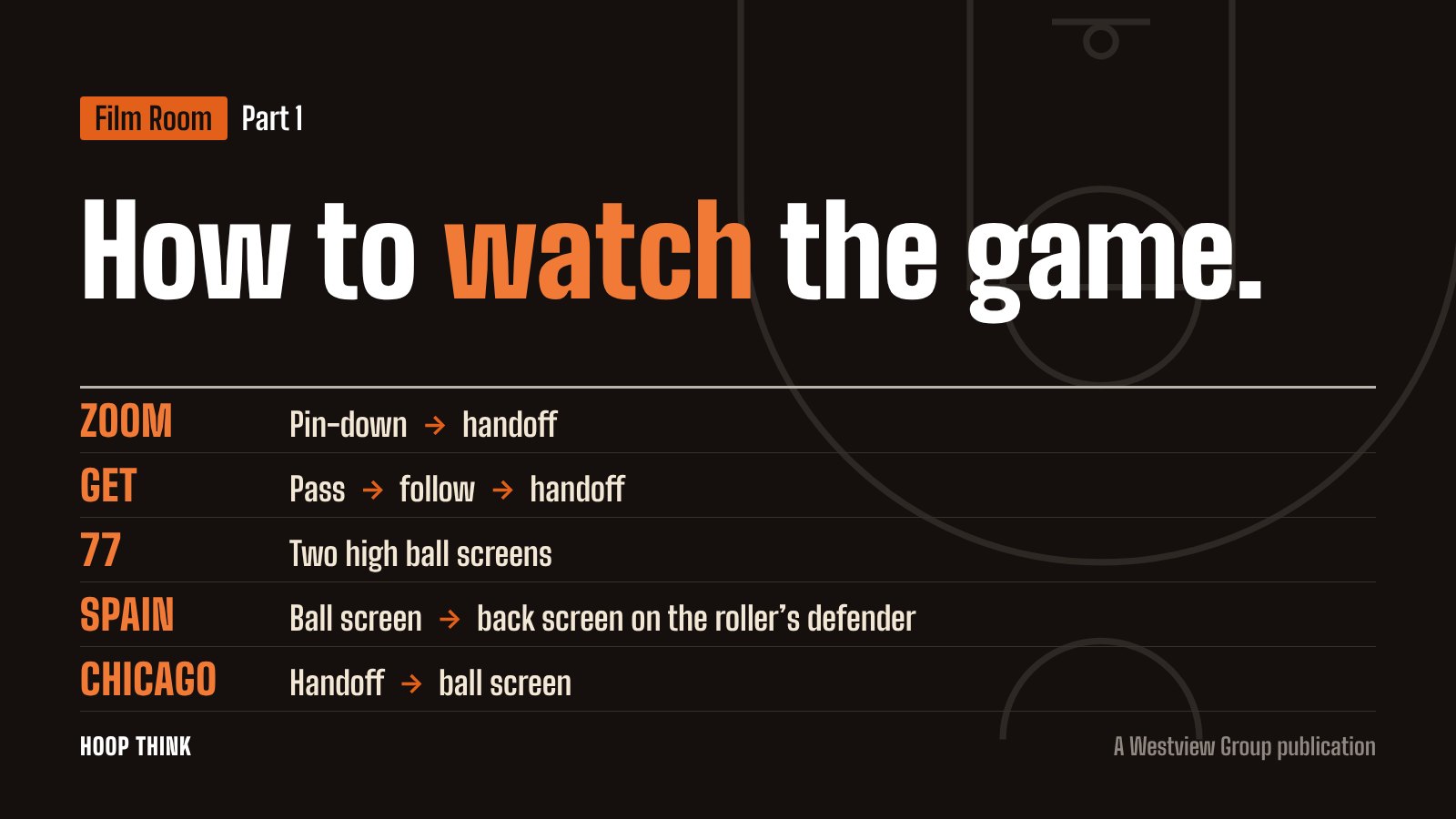
| Zoom | Pin-down → handoff |
| Get | Pass → follow → handoff |
| 77 | Two high ball screens |
| Spain | Ball screen → back screen on the roller’s defender |
| Chicago | Handoff → ball screen |
| 77 Get | Pitch to the second screener → first screener screens off the ball → handoff with the second screener |
Don’t give yourself credit just for naming the action. Ask:
- What advantage did it create?
- Which defender had to make a decision?
- What happened when the defense took away the first option?
That’s how you move from watching the game to studying it.
Next in this series: how to defend these actions with a plan — not just yell “switch” and hope everybody figures it out.
💬 Send me the film
- Which of these five does your team run the most?
- Which one gives your defense the most trouble?
- Did you catch a 77 Get this week? What did the defense do?
Drop a clip of your team running one of these and tag @HoopThink. I’ll break it down. 👇
Keil Moore is the Managing Partner of The Westview Group and editorial lead of HoopThink, The Intelligence Layer of Basketball. He is a former ESPN National Recruiting Analyst and former Director of Scouting at ProspectsNation.
📚 Further film study
- Bball Vault — Get Action (Pass-and-Follow Dribble Handoff)
- MBTR — Get Action (Give Back Hand-Off) Compilation (video)
- The Hoops Geek Play Library — “77” or “Double Drag”
- Coach Hoops — “77” Double Drag
- Sam Bourne — Basketball Double Ball Screen Offense (77 Action) (video)
- BBall Playbook — Double Drag
- The Report: UNLOCKED — Play Vault: “77 Double Get”
- BBALLBREAKDOWN — How Spain Pick and Roll Took Over the NBA (video)