The Game Offense & Skill Development
The Ball Screen Has Two Defenders. Your Guard Is Reading One.
Every ball screen is a 2-on-2 problem. Most guards solve it like it’s 1-on-1. 🏀
Watch a young guard come off a high ball screen. Her eyes are on one thing: her own defender. Did she go over? Did she go under? That’s a real read, and it’s where most player development stops.
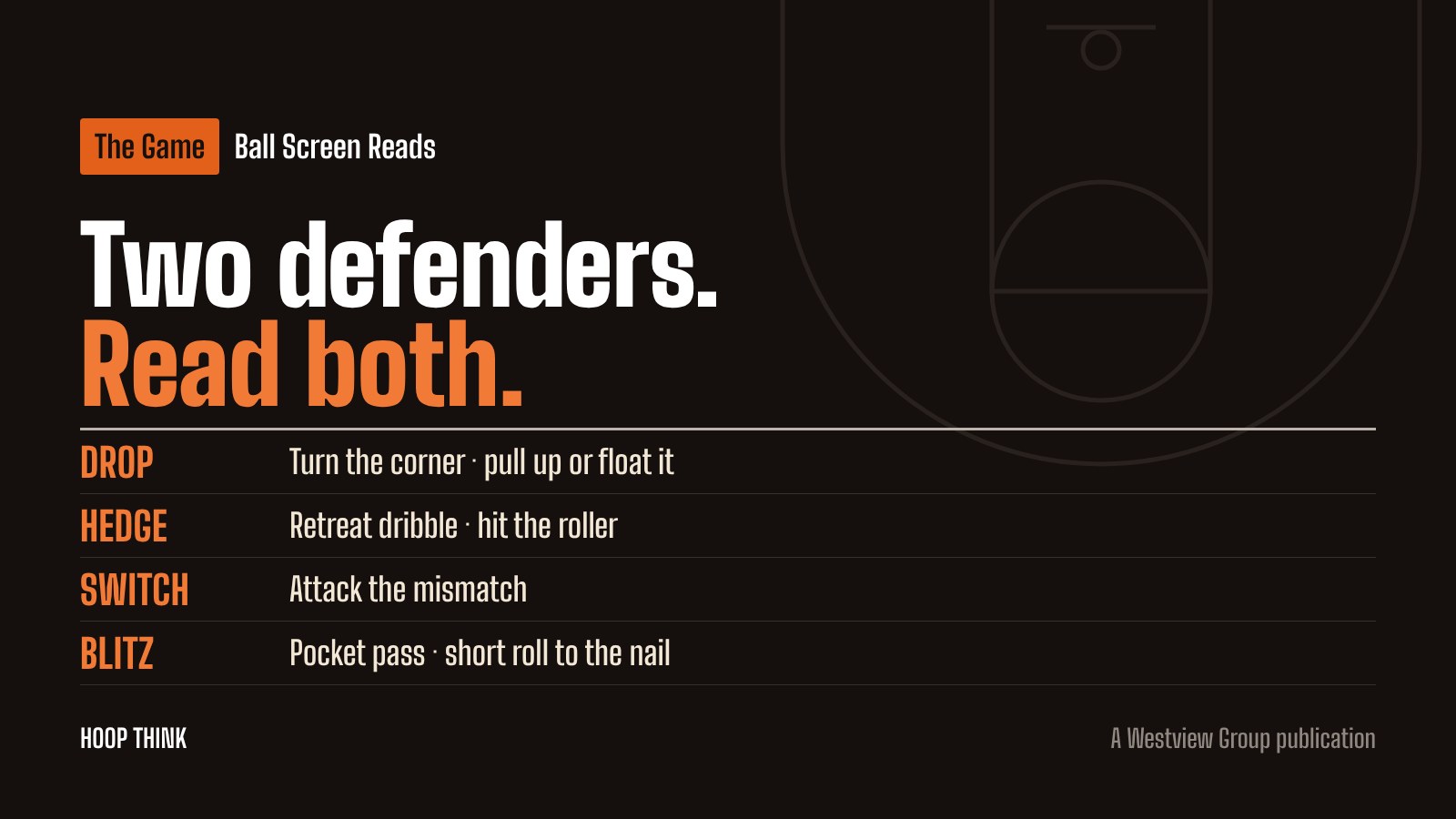
But the right play almost never depends on her own defender alone. It depends on what the screener’s defender does. Drop back, jump out, switch, or trap: four coverages, four different answers. A guard who only reads her own defender is guessing on half the problem, every single possession.
This piece covers three things:
- 🔎 The two defenders, and the read each coverage calls for
- 🪜 A ladder that teaches those reads one decision at a time, from 2v1 to 5v5
- ✂️ One wrinkle, a cut that changes what the screener reads and turns her into the playmaker
🔎 Two Defenders, Two Reads
Read one: her own defender. This is the read most guards already make.
- Goes over the screen (chases): She’s behind you. Turn the corner and get downhill.
- Goes under the screen: She’s giving you space. Shoot it behind the screen, or have the screener re-screen.
- Refuses the screen (ice): She’s forcing you away from it. Reject the screen and attack the other way.
Read two: the screener’s defender. This is the read that decides the play, and it decides it for both offensive players.
| Coverage | What the screener’s defender does | Handler’s best read | Screener’s best read |
|---|---|---|---|
| Drop | Sits back in the paint at the level of the rim | Turn the corner and pull up, or float it before she can step up | Roll to pin her, or pop into the space she leaves |
| Hedge / show | Jumps out high to stop the turn, then recovers | Retreat dribble and keep it alive; hit the roller as the big recovers | Roll hard behind the hedge, or slip it early |
| Switch | Takes the handler; the guard takes the screener | Attack the slower defender, or feed the mismatch | Seal the smaller defender and duck in |
| Blitz / trap | Both defenders go to the ball | Get off it fast: pocket pass to the short roll | Short roll to the nail and play 4-on-3 |
Look at the right-hand column. The screener has a read too, and it changes with every coverage. A screener who rolls to the rim every time, no matter what, is making the defense’s job easy.
👀 The Third Defender: The Read After the Read
Win both reads and the defense still has one more answer: the low man. She’s the weak-side defender sitting near the rim, and her job is to “tag” the roller, bumping her off her path long enough for the big to recover.
When the low man tags, she leaves someone, usually the corner shooter.
- Low man tags the roll: The corner is open. Skip it or kick it.
- Low man stays home: The roll is open. Hit it.
- Low man splits the difference: The short roller at the nail gets to pick.
That’s why the best ball-screen guards look past the screen before they come off it. They know where the low man is before the big ever shows them the coverage.
🪜 The Ladder: One New Decision Per Rung
You can’t teach all three reads at once. Players freeze. So we climb a ladder: eight rungs, from 2v1 to 5v5, and every rung adds exactly one new decision.
The architecture comes from Coach Tim Brady’s Ball Screen Ladder teaching board. Each rung gets a decision, a constraint that forces it, a cue to read, and a standard to clear before moving up. The rungs below are my version.
| Rung | The one new decision | The constraint | The cue | Standard to move up |
|---|---|---|---|---|
| 1 · 2v1 | Score or pass, based on where the big is | Two dribbles max | The big’s level: up at the screen or back at the rim | Right read on 4 of 5 |
| 2 · 2v2 | Use the screen or reject it | Coach tells the guard’s defender over, under, or ice; the handler isn’t told | The on-ball defender’s top foot | 4 of 5 |
| 3 · 2v2 | Name the coverage within one dribble | Coach shows the big a coverage card the offense can’t see | The big’s first step | Names it and makes the play, 4 of 5 |
| 4 · 2v2 | The screener’s read: roll, short roll, pop, or slip | She commits before the handler’s second dribble | Where the big’s chest points | 4 of 5 |
| 5 · 3v3 | Read the low man: does she tag the roll? | Add a corner shooter and her defender | The low man’s feet leaving the corner | Kicks to the corner when she tags, 4 of 5 |
| 6 · 3v3 | The wrinkle: a 45 cut takes the dunk spot | The wing cuts to the baseline / short corner as the screen hits | The cutter’s defender: follow her or help? | Screener catches at the nail and makes the next play, 4 of 5 |
| 7 · 4v4 | The short roller’s 4-on-3: score, dump, or kick | No shot from beyond the nail | The help defender who leaves her player | Right pass on 4 of 5 |
| 8 · 5v5 | All of it, live | Defense changes coverage every possession | Everything above | 1 point per trip or better over 20 trips |
Two rules keep the ladder honest. Nobody moves up until the standard is met, and the defense gets to win. A rung where the offense scores every time is a rung where nobody had to read anything.
✂️ The Wrinkle: Take the Dunk Spot, Move the Roller
Here’s the wrinkle I’m adding to the ladder at rung 6. As the ball screen hits up top, the wing on the 45 cuts to the baseline and the short corner.
Basket at the topZigzag: dribbleSolid arrow: cut or rollDashed: the old full roll
- A1 comes off the screen reading two defenders: hers and the screener’s.
- B3’s 45 cut lands in the dunk spot the roller wants.
- CSo 5 short-rolls to the nail and becomes the playmaker.
- DThe weak side drops from two players to one. Its defender has to choose.
Three things happen at once:
- The cutter takes the dunk spot. If the screener rolls all the way to the rim, she and the cutter arrive at the same place at the same time. So the screener’s read changes: a short roll or pop to the middle of the paint, at the nail or the free-throw line.
- The screener becomes the playmaker. At the nail she can score, hit the cutter on the baseline, or kick out. That’s a 4-on-3 with the ball in the middle of the floor.
- The weak-side defender has to choose. The cut takes the weak side from two players to one. The defender who was guarding two now has one, with a cutter heading to the strong side. Follow the cutter, tag the short roll, or stay home: every answer opens something.
That last point is the real value. The wrinkle doesn’t just create a shot. It creates a decision for a defender who was comfortable a second earlier.
🗓️ How to Run It
- Cadence: Climb the full ladder two or three times over two or three months. The first pass teaches the reads. The second shows who kept them. The third is where you add coverages they haven’t seen yet.
- Session shape: About an hour of skill work first, then about 90 minutes on the ladder. The skill hour covers footwork off the screen, the pocket pass, the pull-up, and the screener’s angles. The ladder is where those skills become decisions.
- Rotate the roles: Everybody screens, and everybody handles. A guard who has set ball screens reads the big better. A post who has handled knows what the guard needs.
- Chart the read, not the make: A made shot off the wrong read is still a wrong read. Mark every rep “right read” or “wrong read,” and let the standard come from that column.
The standard is the whole point. “We worked on ball screens” means nothing. “Twelve of fifteen players cleared rung 5” tells you exactly where your team is.
👨👧 For Parents: What to Watch on Saturday
You don’t need a whiteboard to see whether your player reads ball screens. Watch four things:
- Before the screen: Does she look at the screener’s defender, or only her own?
- Off the screen: Does she make the same play every time, no matter what the big does?
- The screener: Does she roll to the rim every time, or does what she does change?
- Against a trap: Does the ball get out in one pass, or does she try to dribble through two defenders?
The same play every time is a habit, not a read. Different plays against different coverages is what development looks like.
🏁 The Bottom Line
A ball screen isn’t a play. It’s a question the defense answers, and your players have to read the answer. Teach your guard to read two defenders, then three. Teach your screener that she has a read too. Then add the wrinkle that turns her into the playmaker.
💬 Coaches, I want to hear from you
- Which coverage gives your guards the most trouble: drop, hedge, switch, or blitz?
- Does your screener have a read, or does she roll to the rim every time?
- What’s your answer when the low man tags?
- Have you run a cut into the dunk spot to move your roller to the nail? What did it open up?
Hit my DMs, or reply to the HoopThink Briefing when it launches December 1. 👇
Credit: The ladder structure (one new decision per rung, with a constraint, a cue and a standard to move up) comes from Coach Tim Brady’s Ball Screen Ladder teaching board. The rungs here are my adaptation.
Keil Moore is the Managing Partner of The Westview Group and editorial lead of HoopThink, The Intelligence Layer of Basketball. He is a former ESPN National Recruiting Analyst and former Director of Scouting at ProspectsNation.